← Back to Portfolio
Remote Sensing

MODIS GPP Super-Resolution with Sentinel-2

A two-stage framework for enhancing MODIS Gross Primary Production (GPP) from 500 m to 20 m using Sentinel-2 vegetation information and environmental variables, without requiring spatially dense high-resolution GPP ground truth.

Research Overview Public 🔒 Methodology Restricted MODIS GPP Sentinel-2 500 m → 20 m Super-Resolution
01 · Overview

From coarse MODIS GPP to spatially detailed 20 m estimation

Gross Primary Production (GPP) is widely used to characterize ecosystem carbon uptake, but MODIS GPP is available at a relatively coarse 500 m spatial resolution. This study investigates whether Sentinel-2 vegetation information and environmental variables can reconstruct spatially detailed GPP at 20 m without requiring a spatially complete high-resolution GPP target.

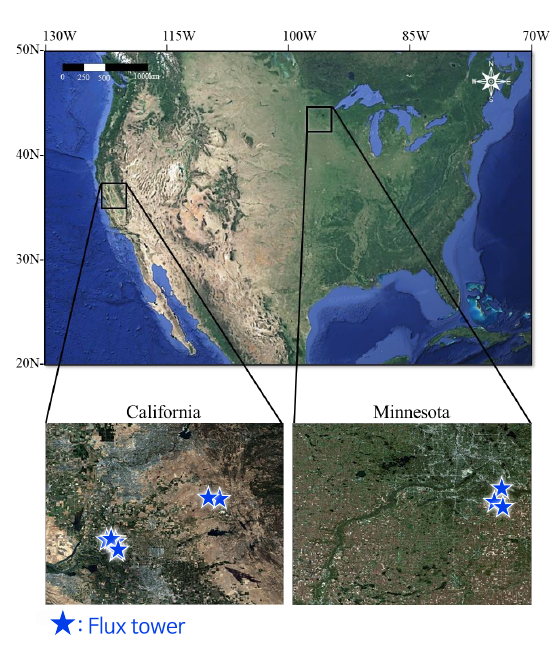
Study areas and flux-tower locations
Study area and data. MODIS GPP at 500 m, Sentinel-2 observations at 20 m, and daily flux-tower GPP are evaluated across Minnesota and California.
02 · Key Contributions

Turning sparse supervision into spatially detailed carbon-uptake estimates

Unlike conventional image super-resolution, fine-resolution GPP does not have a spatially dense ground-truth target. This research addresses the resulting learning and validation challenge by connecting coarse MODIS productivity estimates with fine-scale Sentinel-2 observations and ecological knowledge.

01

Super-resolution without dense 20 m GPP ground truth

Formulates GPP downscaling as an estimation problem constrained by coarse productivity information and fine-resolution environmental observations, rather than relying on unavailable 20 m GPP labels.

Limited-label Learning
02

Cross-resolution reference-guided learning

Introduces a progressive auxiliary-to-main learning framework designed to transfer vegetation-related fine-scale structure to GPP reconstruction while retaining information from observed MODIS GPP.

Cross-scale Learning
03

Ecologically constrained spatial reconstruction

Integrates coarse-scale consistency and vegetation–productivity relationships to support plausible spatial patterns, rather than optimizing image sharpness alone.

Physical Relevance
03 · Approach at a Glance

Bridging the 500 m-to-20 m resolution gap

The approach combines MODIS GPP with Sentinel-2 vegetation information and environmental context to estimate 20 m productivity patterns. Its central research contribution is learning and evaluating spatial detail when pixel-wise 20 m GPP ground truth is unavailable. The architecture, supervisory relationships, and specific training objectives are restricted to the detailed methodology.

MODIS source
500 m
Coarse GPP observations
Target scale
20 m
Fine-scale GPP estimation
Resolution ratio
25×
Spatial sampling interval
Independent evaluation
10
Flux towers across two states
04 · Minnesota Results

Improved agreement with flux-tower GPP in Minnesota

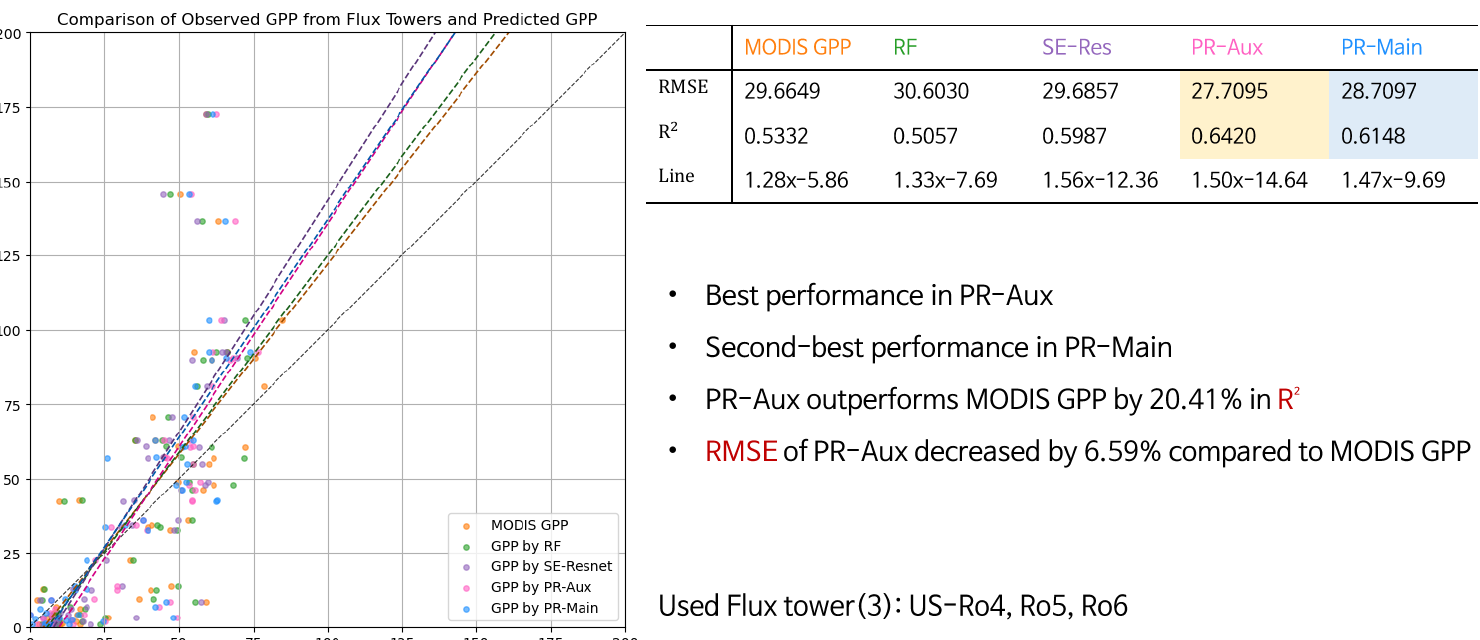
Independent validation uses three flux towers: US-Ro4, US-Ro5, and US-Ro6. Among the compared estimates, PR-Aux provides the strongest aggregate performance, while PR-Main also improves the overall relationship relative to the original MODIS GPP.

PR-Aux performs best in the regional aggregate

PR-Aux achieves RMSE 27.7095 and R² 0.6420, compared with RMSE 29.6649 and R² 0.5332 for MODIS GPP. The presentation reports a 6.59% reduction in RMSE and a 20.41% improvement in R² relative to MODIS GPP.

Minnesota · PR-Aux R² 0.642

RMSE 27.71 · Validation across 3 flux towers

Minnesota flux-tower validation results
Minnesota validation. Aggregate comparison across US-Ro4, US-Ro5, and US-Ro6. PR-Aux has the lowest RMSE and highest R² among the evaluated methods.
05 · California Results

Stronger regional performance from the main super-resolution model

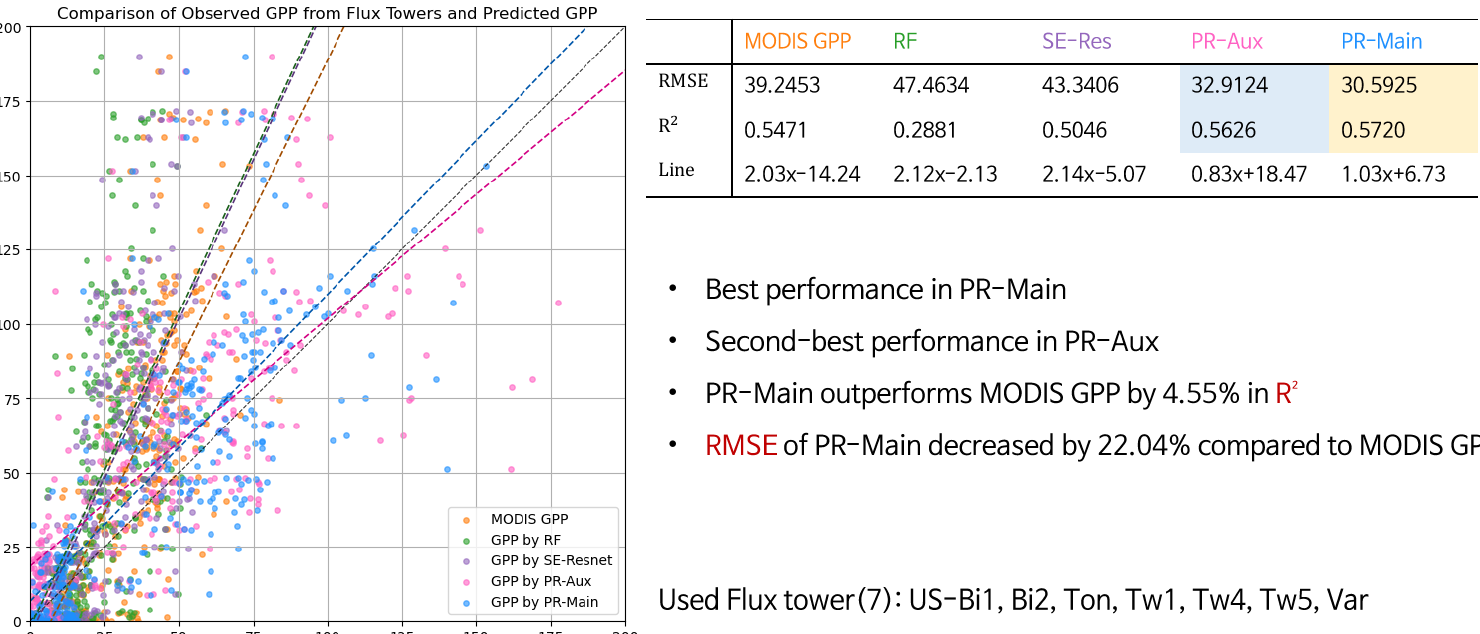
California validation uses seven flux-tower sites: US-Bi1, US-Bi2, US-Ton, US-Tw1, US-Tw4, US-Tw5, and US-Var. In this region, PR-Main provides the strongest aggregate performance among the evaluated methods.

PR-Main reduces error relative to MODIS GPP

PR-Main achieves RMSE 30.5925 and R² 0.5720, compared with RMSE 39.2453 and R² 0.5471 for MODIS GPP. The presentation reports a 22.04% reduction in RMSE and a 4.55% improvement in R² relative to MODIS GPP.

California · PR-Main RMSE 30.59

R² 0.572 · Validation across 7 flux towers

California flux-tower validation results
California validation. Aggregate comparison across seven flux-tower sites. PR-Main achieves the lowest RMSE and highest R² among the evaluated approaches.
06 · Spatial Analysis

Recovering fine-scale GPP patterns while constraining unrealistic values

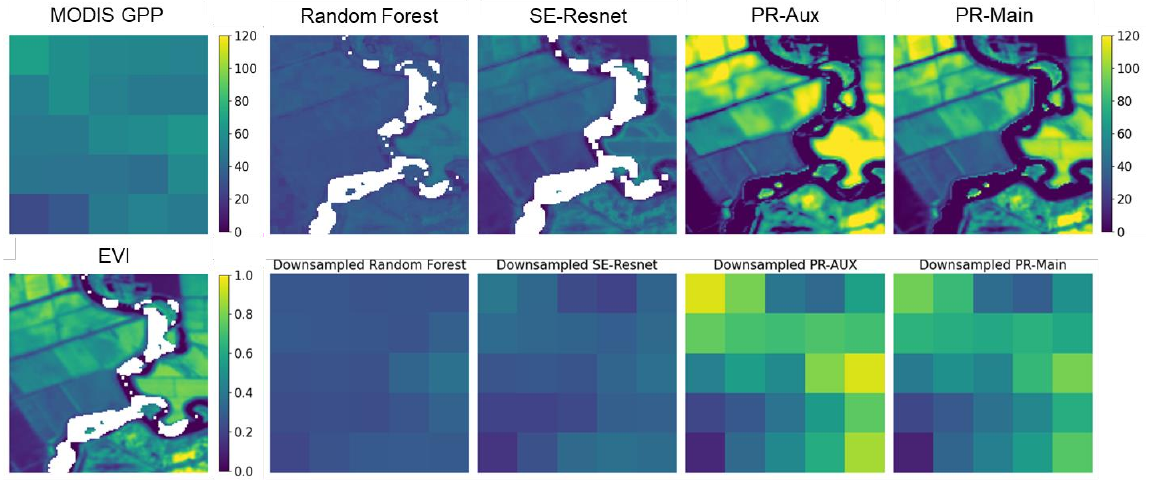
The spatial analysis focuses on limitations of coarse MODIS GPP, including missing or weakly represented productivity patterns in non-vegetated and heterogeneous areas. High-resolution Sentinel-2 reference information enables finer spatial variation, while the ecological relationship loss discourages implausible GPP values.

Qualitative GPP visualization comparison
Qualitative spatial comparison. The proposed model reconstructs spatially detailed 20 m GPP patterns using Sentinel-2 reference information while maintaining coarse-scale and ecological constraints.
07 · Publication

Conference presentation

This work was presented at the 2025 IEEE International Geoscience and Remote Sensing Symposium (IGARSS).

MODIS GPP Super-resolution Using Reference-based Model with Sentinel-2

Hyebin Park, Seonyoung Park
2025 IEEE International Geoscience and Remote Sensing Symposium (IGARSS)
🔒
Restricted · Detailed Methodology

Detailed technical methodology

The research overview, contributions, and preliminary evaluation are public. Model architecture, training procedure, supervisory design, and loss specifications remain password protected while the manuscript is in preparation.